How to Investigate Fraud and Abuse Signals With OSINT
A suspicious account rarely arrives with a confession attached. It arrives with fragments: an email used on a disputed order, a phone number from a phishing message, a username reported by another user, an IP from a risky login, or a wallet that received funds.
OSINT can show whether the sources an investigation can reach contain fraud, scam, spam, phishing, or abuse indicators tied to those signals. But the hard part is attribution. A complaint about a recycled phone number may describe its former user. A copied scam warning may look like several independent reports. A wallet near a flagged cluster is not automatically controlled by that cluster.
This guide explains how to investigate fraud with OSINT without turning weak associations into verdicts, then shows how DefenceCore structures the same work.
What counts as a fraud or abuse signal?
A useful signal is an observable fact tied to a source, not a general feeling that an identifier “looks bad.”
Examples include:
- repeated spam or scam reports tied to the same phone number;
- a domain or email address named in phishing or abuse reports;
- a disposable email domain used where an established business identity is claimed;
- breach records that materially contradict the identity presented in the case;
- linked accounts with a documented history of abuse;
- infrastructure reused across several suspicious events;
- a wallet’s defined proximity to a flagged on-chain cluster;
- a recently activated or non-fixed VoIP line that conflicts with the claimed context.
Some of these are stronger than others. A dated, attributable report describing the same conduct is different from an anonymous comment saying “scammer.” A technical mismatch can justify review without proving intent. The investigation must preserve those distinctions.
Step 1: Start with the event, not the identifier
Write down why the case exists. Was there a chargeback, account takeover alert, phishing message, impersonation report, abusive signup, or suspicious transaction?
The event determines what evidence matters. A VoIP number is common and legitimate in many contexts; it becomes more relevant when an account claims to use a long-held personal mobile number. A newly registered domain is not automatically malicious; it matters more when the domain is sending urgent invoices under an established company’s name.
Record:
- the triggering event;
- the identifiers involved;
- the claimed identity or organization;
- the time window;
- any known-good reference data;
- the decision the investigation needs to support.
This keeps the case focused and prevents a pile of unrelated adverse mentions from becoming the conclusion.
Step 2: Validate and enrich each starting signal
Run the basic checks appropriate to each identifier.
For an email, inspect its domain, mail infrastructure, public mentions, account history, breach exposure, and disposable-email status. For a phone, check validity, country, carrier, line type, port or SIM-swap signals where available, spam reports, and linked accounts. For an IP, examine network ownership and relevant reputation context. For a wallet, review transaction patterns, cluster relationships, and defined proximity to known risks.
If the case begins with a suspicious address, the email fraud investigation guide provides the full manual sequence. For phone-led cases, start with phone number OSINT.
Treat enrichment as context. A single technical property rarely proves fraud.
Step 3: Search for attributable adverse history
Now look for reports that name the identifier exactly and preserve the source.
For each result, ask:
- Does the source show the exact identifier, or only a similar one?
- When was the report created?
- Does it describe specific behavior?
- Is the source primary, or is it copying another page?
- Could the identifier have been reassigned, spoofed, or compromised?
- Does another independent source describe the same pattern?
Exact matching matters. So does time. Phone numbers are recycled, usernames change hands, domains expire, and compromised accounts can be used by someone other than their owner. A valid report may still be attributed to the wrong present-day entity if the timeline is ignored.
Step 4: Separate identity linkage from risk
Before applying an adverse report to the subject of the case, establish that the reported identifier belongs to the same entity.
Suppose a username has scam complaints, and a breach record connects a similar username to the case email. That is a lead, not yet a finding about the email owner. The link becomes more defensible if an independent profile uses the same distinctive avatar, display name, or contact detail.
This is why fraud investigation depends on entity resolution. First determine which names, emails, phone numbers, and usernames are defensibly linked. Then assess the risk signals attached to the resolved identity.
If the identity link is weak, the risk conclusion must remain weak too.
Step 5: Look for patterns, not just bad mentions
One adverse mention can be noise. A pattern across time, sources, or identifiers is more useful.
Common patterns include:
- the same phone, email, or wallet appearing in several reports describing similar conduct;
- multiple accounts sharing infrastructure and repeating the same abuse technique;
- a newly created identity with disposable contact details and no corroborating history;
- an established identifier suddenly changing behavior after a likely compromise;
- several identifiers that resolve to conflicting names while operating together in the same event.
Patterns should still be stated precisely. “Three independently sourced phishing reports named this domain over six months” is evidence. “This person is a fraudster” is a conclusion the sources may not permit.
Step 6: Write a bounded risk conclusion
Use language that reflects both severity and confidence.
- High-severity, high-confidence: a well-corroborated identity link and several specific, attributable adverse signals.
- High-severity, lower-confidence: a serious signal, such as wallet proximity to a flagged cluster, but limited evidence that it reflects control or intent.
- Medium: a material inconsistency or repeated low-level abuse history that justifies review.
- Low: a weak, old, or single-source mention worth retaining as a lead.
- No signal found: no relevant adverse evidence appeared in the sources evaluated.
- Not evaluated: a source or check was unavailable or required another identifier.
“No signal found” is not a safety certification. It is a scoped statement about the evidence that was actually evaluated.
Run the fraud-and-abuse investigation in DefenceCore
DefenceCore turns the goal into a direct question:
Do public sources contain attributable fraud, scam, spam, phishing, or abuse indicators?
Paste the email, phone number, username, IP, or wallet attached to the case. DefenceCore investigates the starting signals, follows useful pivots, resolves which attributes appear to belong together, and evaluates defined risk rules.
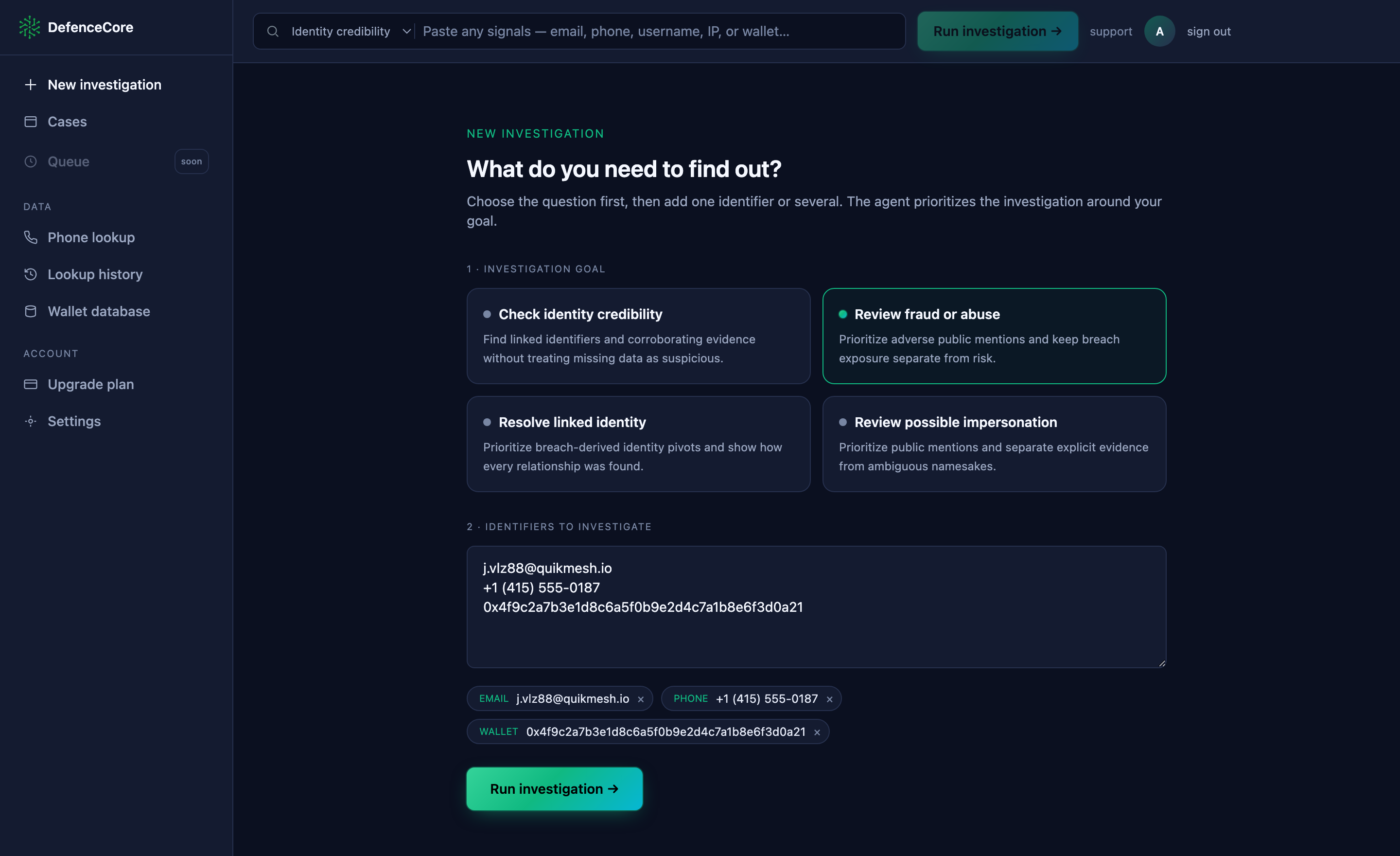 Set the goal to review fraud or abuse, then add the case signals. The agent prioritizes adverse, attributable evidence over generic enrichment.
The report separates:
- findings, which state what a source returned;
- identity links, which show how confidently an attribute belongs to the resolved entity;
- risk signals, which fire from defined rules with a severity and basis;
- coverage, which shows what was not evaluated;
- recommended action, which summarizes the supported next step.
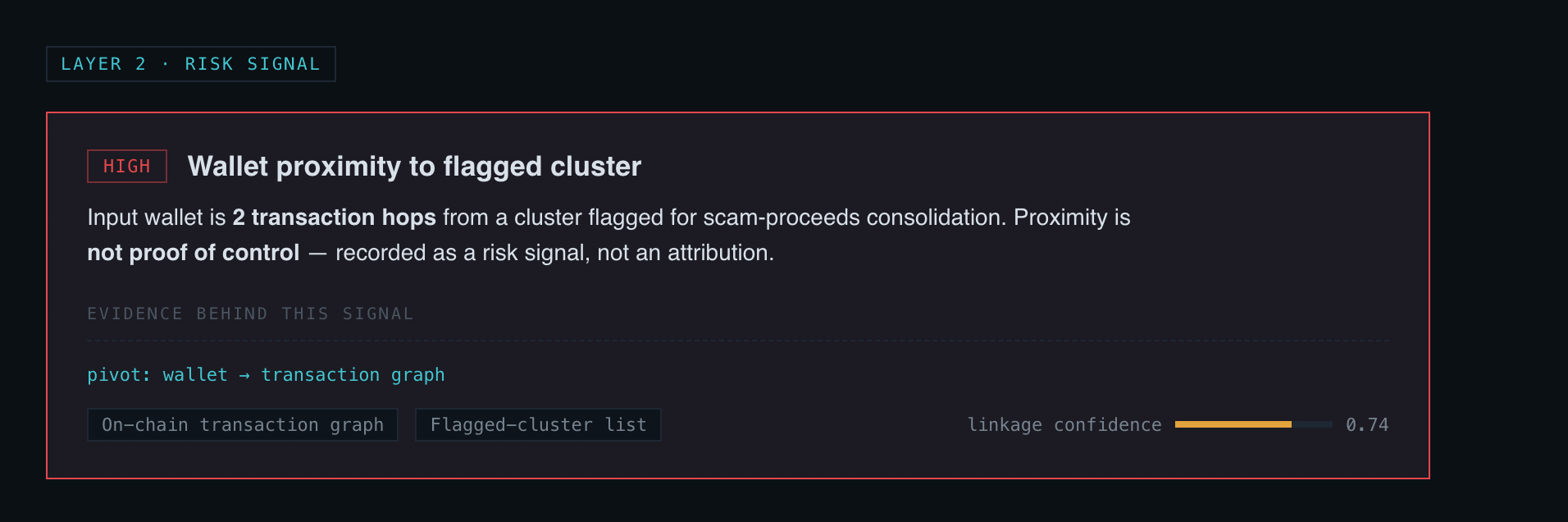 Every fired signal carries its severity, the source behind it, and a confidence score — so a reviewer can see whether it is corroborated or still a single-source lead.
This prevents a common failure in automated risk tools: blending uncertain identity linkage and serious adverse evidence into one unexplained score.
How to review the case
Read the highest-severity signal first, then trace it backward.
Check the exact source. Confirm that the identifier matches. Review the date. Inspect the identity link that attaches the signal to the case. Then look for corroboration or an alternative explanation such as number recycling, spoofing, a compromised account, or shared infrastructure.
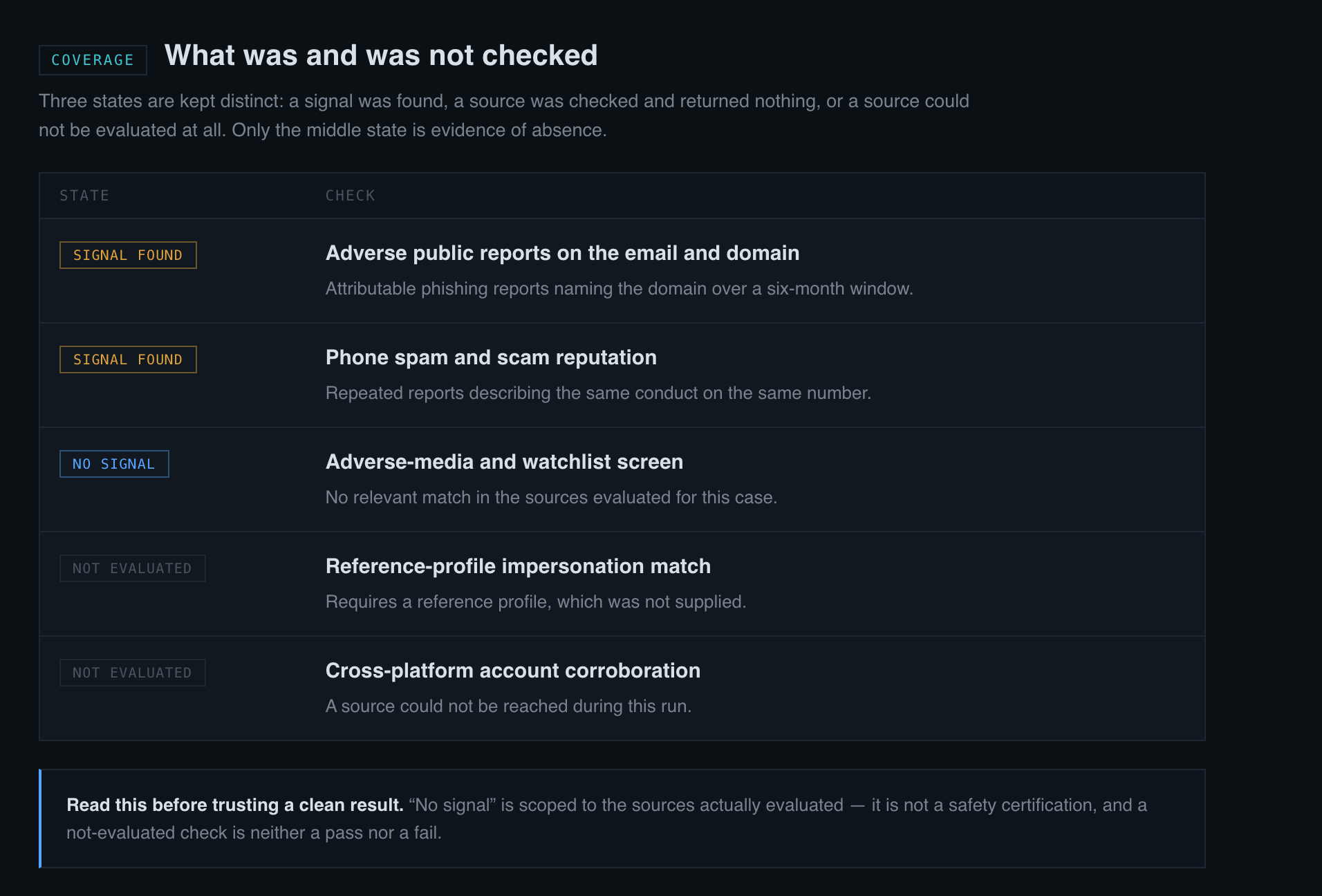 Coverage keeps three states distinct: a signal was found, no signal was found in an evaluated source, or the source could not be evaluated at all. Only the middle case is evidence of absence.
If the case includes a wallet, remember that on-chain proximity is not attribution. If it includes a displayed caller ID, remember that the caller may have spoofed an unrelated person’s number.
The recommended action should follow the evidence. A strong, corroborated pattern can justify escalation or containment. A single-source lead may justify collecting another identifier. A partial-coverage case may need manual review rather than an automatic decision.
Try it on a live fraud queue case
Choose a legitimate case that already has a suspicious signal and a defined business purpose. Add everything you have rather than forcing the investigation to begin from one field.
DefenceCore will return the adverse findings it can source, the confidence of the identity links behind them, and the coverage limits a reviewer needs to know. See a sample report or run an investigation.
For verified organizations. Fraud prevention and security investigations only. DefenceCore is not a people-search tool and does not support locating individuals.