Best Crypto Wallet OSINT Tools for Investigators (2026)
The best crypto wallet OSINT tool is the one that turns a single address into a decision — is this wallet clean, exposed, or close to something flagged, and does it belong to the same person as the rest of the case — instead of leaving you to read raw transactions in a block explorer and guess. Most "wallet checker" products only do one slice of that: a sanctions hit, a scam-list match, or a transaction graph you still have to interpret by hand. This guide breaks down the categories of tools investigators actually use, what each is good for, and where DefenceCore's wallet screening fits.
How to Evaluate a Crypto Wallet OSINT Tool
Before comparing products, fix the criteria. For a fraud, trust-and-safety, or compliance investigator, the ones that matter are:
- Screening breadth — does one check cover sanctions and watchlist exposure, scam and abuse reports, and on-chain cluster proximity, or just one of those?
- Cluster and proximity analysis — can it tell you how many transaction hops separate an address from a cluster already flagged for scam-proceeds consolidation or theft?
- Attribution discipline — does it treat proximity as a risk signal with a confidence score, or does it silently imply that being near a bad cluster means control? Proximity is not proof of control, and a serious tool says so.
- Identity linkage — can the wallet be investigated alongside the email, phone, and username on the case, so on-chain risk joins a resolved identity rather than sitting in isolation?
- Investigation-ready output — a readable, sourced report you can attach to a case, not just a color-coded risk score with no basis.
- Coverage honesty — does it distinguish "screened and clean" from "not evaluated," instead of returning a green light for a source it never reached?
- Abuse safeguards — a defense-first posture and intent screening, which is also what gets a tool approved by security and compliance leadership.
A tool that nails one criterion but forces you to stitch in three others isn't saving you time.
The Categories of Tools
1. Block Explorers
What they do: Show raw on-chain data — balances, transactions, token transfers — for an address (Etherscan and equivalents for other chains).
Best for: Manually inspecting specific transactions when you already know what you're looking for.
Limitation: No risk layer. You see every transaction but no clustering, no sanctions context, and no judgment about whether the address is dangerous. It's a microscope, not an assessment.
2. Address Reputation and Scam Databases
What they do: Tell you whether an address appears on community-reported scam, phishing, or abuse lists.
Best for: The "has anyone flagged this exact address" slice of a check, and surfacing known-bad addresses fast.
Limitation: Only covers addresses someone already reported. A fresh scam wallet with no history comes back clean, and there's no cluster or identity context.
3. Sanctions and AML Screening APIs
What they do: Screen an address against sanctions lists (OFAC and similar) and known illicit-finance designations for compliance workflows.
Best for: Regulatory screening — confirming an address isn't a sanctioned or designated entity before you transact.
Limitation: Built for a compliance yes/no, not investigation. A clean sanctions result says nothing about scam proximity, exposure, or who controls the wallet.
4. Blockchain Analytics and Tracing Platforms
What they do: Heavy-duty transaction tracing and clustering — following funds across hops and grouping addresses into likely-common-control clusters.
Best for: Deep fund-tracing investigations and large-scale analytics programs.
Limitation: Powerful but chain-only and often enterprise-priced and enterprise-complex. The wallet is analyzed in isolation from the email, phone, and username that make up the rest of the case.
5. All-in-One Identity + On-Chain Investigation Platforms
What they do: Screen the wallet — sanctions and watchlist exposure, scam and abuse reports, and proximity to flagged clusters — and investigate it as one signal inside a broader identity graph alongside email, phone, username, and IP, returning a single sourced report.
Best for: Investigators whose case is never just a wallet — a flagged transaction, a payment request, a suspicious signup where the wallet is one identifier among several, and the question is both "is this address risky" and "does it belong to the same entity as everything else."
Limitation: You're consolidating onto one platform rather than assembling best-of-breed point tools — a trade most investigators make gladly to stop pivoting between an explorer, a scam list, a sanctions API, and manual OSINT.
Where DefenceCore Fits
DefenceCore is in the all-in-one category, and wallet screening is now built in. Paste an EVM-style wallet address — on its own or alongside the other signals on the case — and the agent screens it and pivots on it the way it does an email or a phone number.
One run returns:
- Cluster proximity — how many transaction hops separate the address from a cluster flagged for scam-proceeds consolidation, expressed as a risk signal with a confidence score and a stated basis, never as a bare accusation.
- Screening context — sanctions and watchlist exposure and scam or abuse reports, each cited to its source.
- Identity linkage — the wallet resolved into the same identity graph as the email, phone, and username on the case, so on-chain risk is weighed against the rest of the evidence rather than in a vacuum.
- Honest coverage — a check that could not be evaluated is marked as such, not returned as a clean pass.
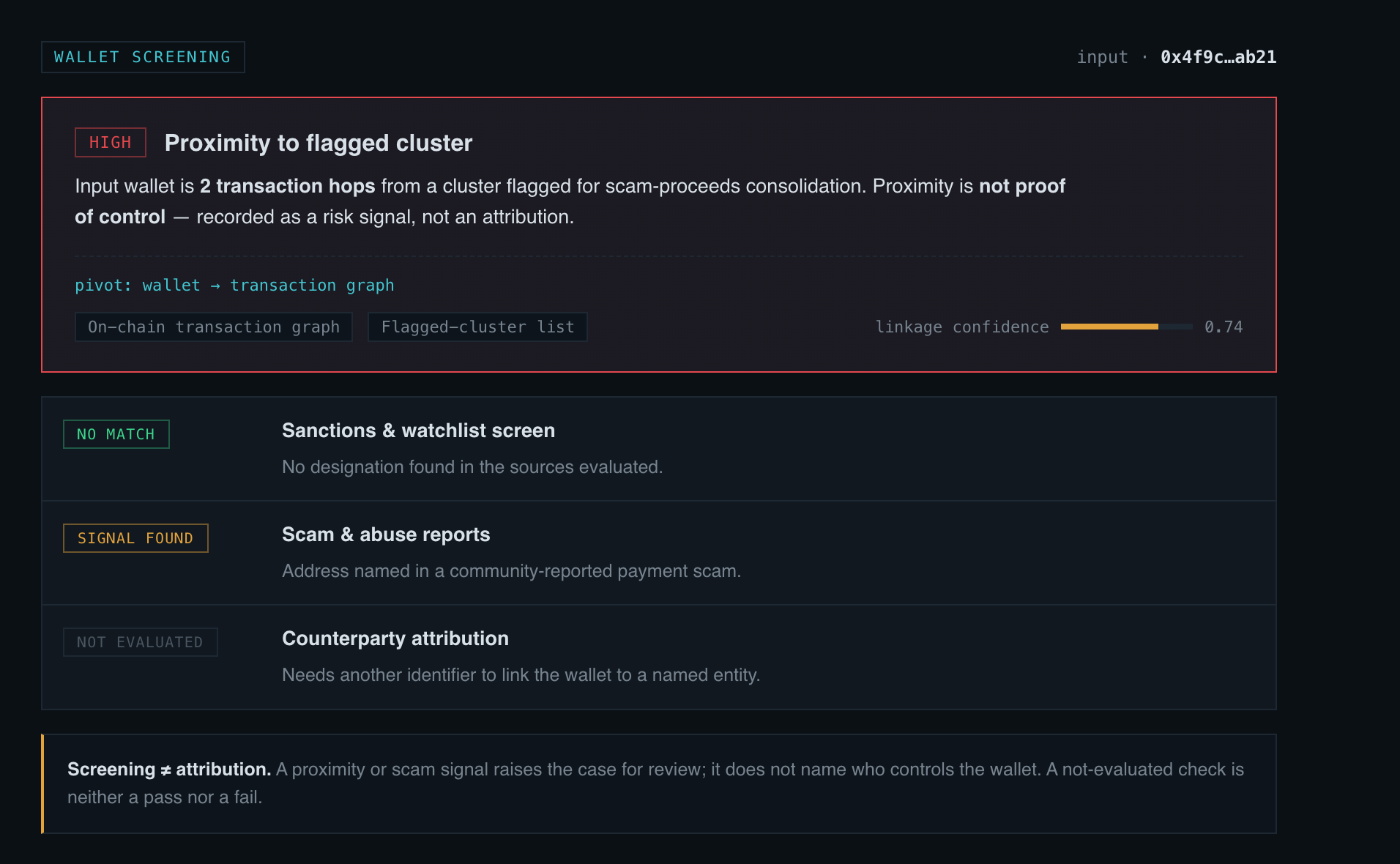 Wallet screening returns proximity, screening context, and confidence in one panel — with cluster proximity framed as a risk signal, not an attribution. (Fictional case.)
Crucially, DefenceCore keeps the discipline that separates a real investigation from a risk score: proximity is not attribution. An address two hops from a flagged cluster raises a case for review — it does not auto-decide it. Every finding carries its source and a confidence level, so a reviewer can act on the evidence rather than a black-box number.
The quickest way to try it is the free crypto wallet screening tool — no signup. Paste an address and check it against DefenceCore's wallet intelligence database in seconds. To see the full picture, view a sample report with a wallet-cluster proximity finding inside a fictional investigation, or run an investigation. Pricing is on the pricing section.
A Simple Decision Guide
- You need to read specific transactions by hand → a block explorer.
- You only need to know if an address was reported as a scam → an address reputation or scam database.
- You need a regulatory sanctions yes/no → a sanctions and AML screening API.
- You need deep, chain-only fund tracing at scale → a blockchain analytics platform.
- Your case is a wallet plus other signals, and you need risk and identity together → an all-in-one platform like DefenceCore.
Frequently Asked Questions
What is the best crypto wallet OSINT tool for investigators? The best tool is one that screens an address for sanctions and scam exposure, measures its proximity to flagged clusters with a confidence score, and links the wallet to the rest of the identity on the case — as a sourced report. All-in-one platforms like DefenceCore serve this job, whereas block explorers, scam lists, and sanctions APIs each cover only one layer.
Does proximity to a flagged wallet cluster prove the address is criminal? No. Proximity is a risk signal, not proof of control. Funds move through many hands, and an address can sit near a bad cluster as an unlucky counterparty two hops removed. A defensible tool reports proximity with a confidence score and a stated basis, so it raises a case for review rather than deciding it.
Can a crypto wallet be investigated alongside an email or phone number? Yes. A wallet is strongest as one signal among several. DefenceCore accepts a wallet alongside email, phone, username, and IP, and resolves them into one identity graph so on-chain risk is weighed against the rest of the evidence.
What does it mean when a wallet screen comes back clean? It means no adverse signal appeared in the sources that were successfully evaluated. It is not a guarantee the address is safe — a fresh wallet may simply have no history yet, and a source that could not be reached is marked as not evaluated rather than treated as a pass.
The Bottom Line
There's no single "best" tool in the abstract — there's the best tool for your job. If your job is deep, chain-only fund tracing, a dedicated analytics platform earns its place. But if your case is a wallet plus an email, a phone, and a username — and the question is both whether the address is risky and whether it belongs to the same entity as everything else — an all-in-one platform that screens the wallet and resolves it into one identity beats assembling an explorer, a scam list, and a sanctions API every time.
Screen a wallet free with the no-signup crypto wallet screening tool, or see a sample report. Related reading: how to investigate a crypto wallet address and how to investigate fraud and abuse signals with OSINT.